
Ai Engineering Hub
93+ Jupyter Notebook projects for LLMs, RAG, agents, and MCP.
Replaces —
Who it's for
A developer building their first RAG pipeline or multi-agent workflow can start with a working notebook and trace exactly how the components connect. The tiered structure lets you start with the beginner projects and progress to advanced systems like multi-agent deep researchers and deployed agentic RAG APIs.
Skip if you need a structured curriculum with graded assignments and completion certificates. The repository has no curriculum track, assessments, or instructor support.
The repository includes parallel implementations of similar workflows using CrewAI, AutoGen, and LlamaIndex. A team deciding which framework to standardize on can run the same agentic pattern across frameworks before making the call.
Skip if your team has already standardized on one framework and needs deep production-level guidance for it. The repository provides breadth across frameworks, not depth in any single one.
The MCP section includes 10+ projects covering custom MCP server setup, RAG via MCP, memory-persistent agents with Graphiti, and multimodal MCP workflows. These are among the most concrete publicly available MCP implementation examples, covering Cursor integrations, LlamaIndex MCP clients, and voice agents backed by MCP.
Skip if you need MCP protocol documentation and specifications rather than code examples. The official MCP documentation covers protocol details more thoroughly.
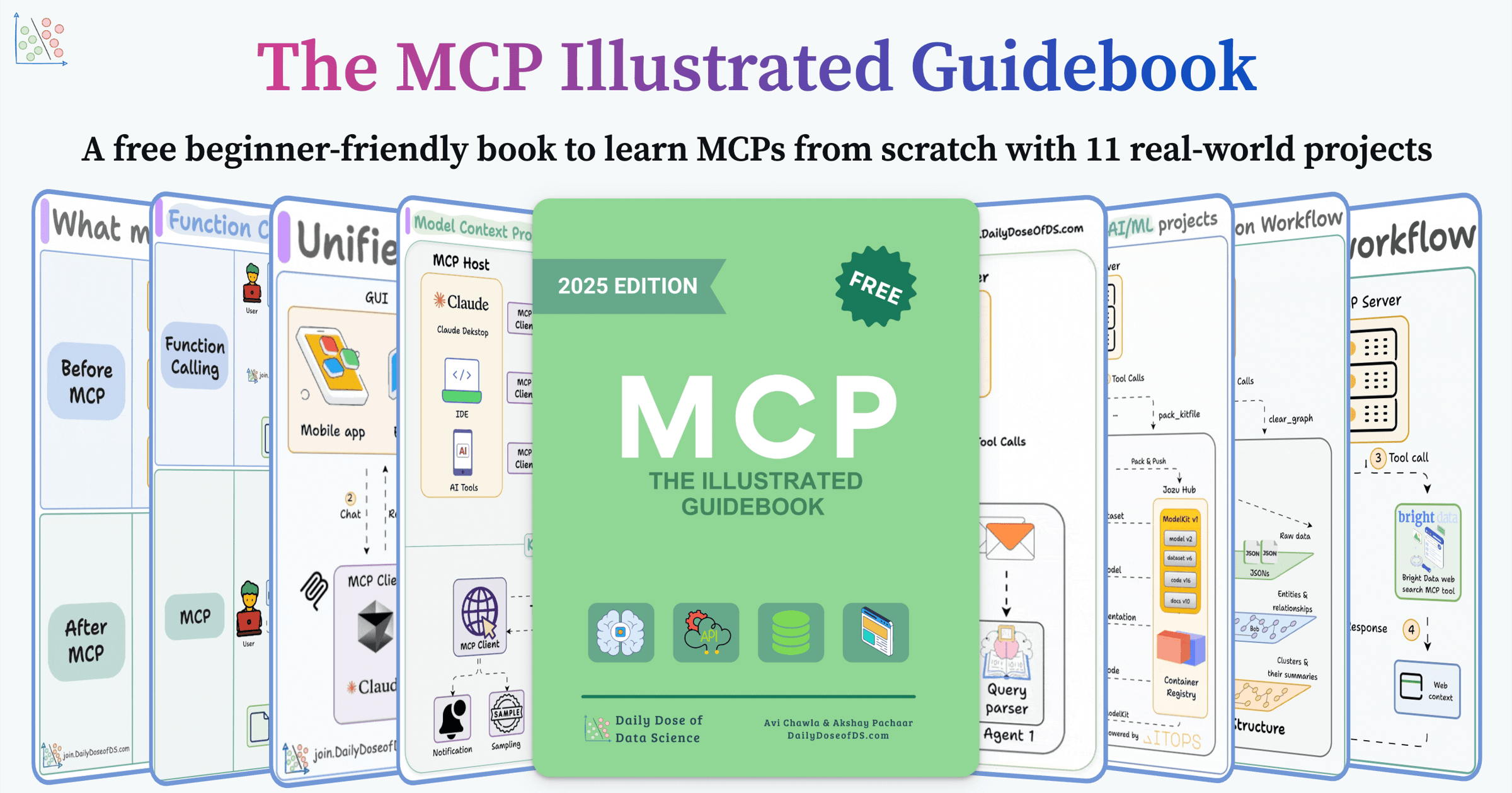
Subscribers to the Daily Dose of Data Science receive the 75-page MCP PDF guidebook covering the Model Context Protocol with structured project explanations alongside the repository code. The newsletter covers over 150,000 AI professionals and announces new projects as they are added.
Skip if you prefer self-contained documentation without a newsletter subscription requirement for the accompanying guidebook.
The problem
Building production AI systems requires selecting and connecting the language model, the embedding pipeline, the retrieval layer, and increasingly MCP servers for tool access. Each component has documentation, but tutorials rarely provide a full end-to-end implementation showing how all the pieces connect and what the complete working code actually looks like. Version mismatches compound the difficulty. A tutorial written for an older version of LlamaIndex, CrewAI, or AutoGen may not run against the current API. Developers spend significant time debugging library compatibility rather than studying the AI engineering pattern they came to learn.
How it works
The 93 projects divide into three tiers. Beginner (22 projects) covers single-component implementations like local chat interfaces and basic RAG. Intermediate (48 projects) covers multi-component systems and agentic workflows. Advanced (23 projects) covers fine-tuning, production deployments, and complex agent systems. Each project is self-contained with its own dependencies.
Projects span the four major areas of modern AI engineering plus voice. The LLM section covers local models including Llama, Gemma, DeepSeek, and Qwen. The RAG section includes audio, multimodal, and SQL-routing variants. The agents section covers multi-agent frameworks including CrewAI, AutoGen, and LlamaIndex. The dedicated MCP section has over 10 projects for building and connecting Model Context Protocol servers.
The intermediate and advanced sections include direct comparison notebooks pairing Llama 4 vs DeepSeek-R1, Qwen3 vs DeepSeek-R1, Claude Sonnet 4 vs o4, and GPT-OSS vs Qwen3. Each comparison uses the same RAG or coding task, so you can evaluate models under identical conditions rather than relying on benchmarks run on different hardware and datasets.
Subscribing to the Daily Dose of Data Science newsletter at join.dailydoseofds.com delivers a free 75-page PDF on the Model Context Protocol with 10+ real-world projects. The newsletter has over 150,000 subscribers. The guidebook provides structured explanations of MCP concepts alongside the repository's runnable code examples.
The repository includes a dedicated AI Engineering Roadmap that maps a structured learning path from Python fundamentals to production AI deployment. It is the recommended starting point for developers who need a clear progression before diving into the project notebooks.
Features
- Three Difficulty Tiers Across 93+ Projects
- LLM, RAG, Agents, MCP, and Voice Coverage
- Side-by-Side Model Comparison Notebooks
- Free MCP Guidebook via Newsletter
- AI Engineering Roadmap for Beginners
How to install
Clone the repository to install and access all notebook projects locally.
git clone https://github.com/patchy631/ai-engineering-hubRecommended for this setup
Strengths
- Updated continuously with recently released models: The repository was last updated on October 30, 2026, and includes notebooks for Llama 4, Qwen3-Coder, GPT-OSS, and Claude Sonnet 4. Paid course platforms take months to produce content on new models; this repository adds implementation and comparison notebooks within weeks of a model's release.
- MIT license with no commercial use restrictions: The MIT license allows you to copy, modify, and use any code in the repository for commercial projects without restriction. You can adapt a notebook's RAG architecture or agent workflow pattern into a production service without any license review.
- Framework coverage across CrewAI, AutoGen, and LlamaIndex: Rather than committing to one framework, the projects demonstrate similar workflows using CrewAI, AutoGen, LlamaIndex, and LitServe. A developer evaluating which agentic framework to standardize on can run comparable implementations across frameworks from the same repository.
Trade-offs
- Requires Jupyter environment setup per project: AI Engineering Hub is a collection of Jupyter Notebooks, not a deployable application. Using it requires Python, Jupyter (or Google Colab access), and the dependencies listed in each project. Projects were created at different times, and dependency version conflicts with newer library releases are possible. The repository has 24 open issues, some related to this.
- Code examples, not production-hardened services: The projects demonstrate patterns and integrations; they are not production-ready services. A RAG notebook connects the key components but typically lacks error handling, authentication, rate limiting, and monitoring that a production deployment needs. Treat the notebooks as architecture references, not drop-in services.
Tech stack
FAQ
Yes. The repository is MIT licensed, which means you can clone it, run any project, and use the code commercially at no cost. The free 75-page MCP guidebook requires subscribing to the Daily Dose of Data Science newsletter, but the newsletter itself is also free.
Each project requires Python, Jupyter Notebook (or access to Google Colab), and the dependencies listed in that project's own requirements file. Some projects require API keys for external services such as OpenAI, AssemblyAI, or GroundX, which each notebook documents. Most beginner projects work with only locally running models.
Yes. The MIT license permits commercial use without restriction. You can copy any notebook's code, adapt it for a production service, or incorporate it into a commercial product without a license review.
Subscribe to the Daily Dose of Data Science newsletter at join.dailydoseofds.com. The 75-page PDF covering the Model Context Protocol with 10+ real-world projects is delivered automatically to new subscribers.
The repository receives regular updates; the most recent commit was in October 2026. Projects for models released in 2025 and 2026, including Llama 4, Qwen3, Claude Sonnet 4, and GPT-OSS, are included. New notebooks are added as models and frameworks release.