
agentswarms
Self-hosted AI agents, swarms, RAG, and BI in one platform
Replaces Crewai, Langsmith
Who it's for
Teams with data in Snowflake, BigQuery, or Postgres can connect those sources directly and build agents that reason over that data using the same governed definitions as their BI dashboards. ETL pipelines and the built-in lakehouse replace a separate orchestration and storage layer.
Your data team has no plans to expose AI-powered analysis to non-technical users. A lighter agent framework like Flowise or Dify handles pure agent tasks without the full BI and data infrastructure.
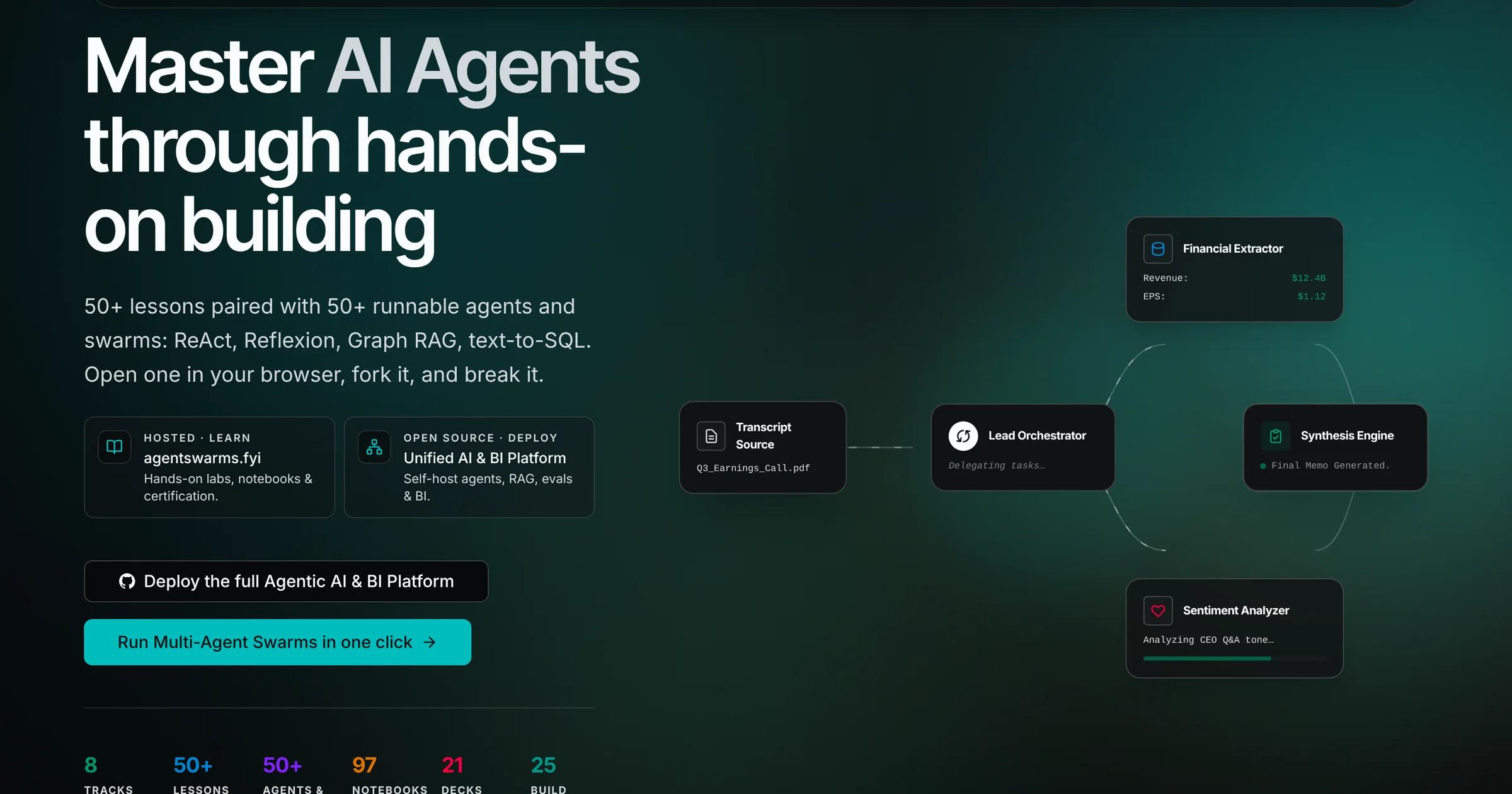
The swarm canvas lets you design, run, and debug multi-agent pipelines without writing orchestration boilerplate. Agent nodes, router nodes, condition branches, human approval steps, and tool calls are assembled visually and can be exported to LangChain or LlamaIndex for production.
You need a production runtime that scales to thousands of concurrent requests. AgentSwarms markets the learning and POC path explicitly; for high-scale inference, a dedicated serving layer is still needed.
The hosted platform at agentswarms.fyi includes 8 curriculum tracks, 50+ lessons, and 97 TypeScript notebooks covering LangChain, LlamaIndex, OpenAI Agents SDK, and Vercel AI SDK, plus failure-mode labs where you diagnose and repair deliberately-broken swarms. The self-hosted platform and the learning curriculum use the same visual builder.
Your team is already past the learning phase and needs a pure deployment tool. The curriculum is irrelevant if your focus is running production workloads rather than building understanding.
The AI Analyst surface lets analysts ask questions in plain language and get answers with the SQL shown as the source. Every number traces back to the query that produced it, so results are verifiable rather than opaque. Charts from queries can be pinned to multi-page dashboards.
Your BI tool (Metabase, Grafana, Tableau) already handles analytical queries well and you only need light AI augmentation. A specialized AI-on-data layer may serve that gap without replacing the whole BI stack.
The problem
Building AI agents that reason over company data requires stitching together an agent framework, a vector store, a data warehouse, a BI tool, and an access-control layer from five different vendors. Each system speaks its own metadata format, so the same business metric appears differently to the agent than to the dashboard, row-level permissions defined in the BI layer do not carry into the agent's queries, and every question a user asks has no auditable trace back to the data it used. The cost of that fragmentation compounds. Teams running Relevance AI, Snowflake, and Power BI independently maintain three access-control models, three audit logs, and three billing relationships. When an agent reports a revenue number that does not match the dashboard, debugging that mismatch requires digging through three disconnected systems. Most teams either accept the discrepancy or stop building the agent layer entirely.
How it works
Design and run multi-agent workflows as a graph. Each node is a step: agent, router, condition, loop, human approval, or tool call. Workflows run from the canvas, from the API, or on a schedule. Published snapshots keep serving until you promote a new draft, so the canvas and production runs stay on separate tracks.
Connect uploads, crawled websites, GitHub repos, and SaaS sources including Google Drive, Notion, SharePoint, Dropbox, and Confluence on a sync schedule. Each collection supports hybrid search, parent-child and Q&A indexing, and per-source access scopes. Storage uses pgvector or Qdrant per collection with two-level dedup.
Query 22 databases and warehouses (PostgreSQL, MySQL, Snowflake, BigQuery, Databricks, Redshift, ClickHouse, and more) in place with read-only encrypted credentials. Sync 17 SaaS apps (Stripe, Shopify, HubSpot, Salesforce, Jira, Zendesk, and others) into datasets with change-following incremental loads.
Ask questions in plain language and get answers with every number cited to the SQL that produced it. The analyst plans each question into steps, writes and runs the query, checks its own work, and exports findings as a branded PDF. Charts from individual steps can be pinned to dashboards or edited and re-run.
Pick a table and a prediction goal (classify, forecast, cluster, detect anomalies, recommend) and a sandboxed trainer profiles the data, tries multiple algorithms under a time budget, and keeps the best model with its metrics and a model card. Trained models score rows back into the lakehouse on a schedule or via a scoped public API, and can function as agent tools.
Move data between systems on a canvas or write ETL in Python. Steps run on a sandboxed kernel where credentials reach process memory only, never the code or container environment. Scheduled jobs include retries, overlap guards, and incremental watermarks. Every successful load triggers a catalog re-crawl so new tables appear for BI, the analyst, and agents.
Features
- Multi-agent swarm canvas
- Hybrid RAG knowledge bases
- 39-connector data layer
- AI Analyst with cited SQL
- No-code ML on your lakehouse tables
- Visual ETL pipeline builder
How to install
Self-hosting uses Docker or Kubernetes with a Supabase backend after cloning the repository.
git clone https://github.com/AgentSwarms-fyi/agentswarmsRecommended for this setup
Strengths
- One semantic layer for agents and BI: Table definitions, row filters, column masks, and access rules are enforced once and govern the agent, the analyst, the ETL, and the dashboard alike. An agent asked about revenue uses the same definition your finance team governs in the catalog. A row filter on a warehouse table binds both the dashboard and the agent query.
- Any model, any warehouse: Model routing covers OpenRouter, OpenAI, Anthropic, Gemini, Bedrock, Azure, OCI, Qwen, Grok, Groq, Ollama, and vLLM. Warehouse connections span Snowflake, BigQuery, Databricks, Redshift, Trino, ClickHouse, Oracle, SQL Server, Postgres, and MySQL. No part of the system is locked to a single provider.
- Columnar lakehouse you own: Tables are stored as zstd Parquet in your own S3-compatible bucket with a Postgres catalog. Compute stays stateless, snapshots give time travel, and nothing is locked in. You can query the same tables from the built-in engine, a Spark cluster, or direct SQL without moving the data.
- Swarm runs survive restarts: Deployed swarm runs checkpoint as they execute. A process restart resumes from the last checkpoint rather than starting over. Human-approval steps park the run until someone decides, and schedules keep serving the last published snapshot until you promote a new draft.
Trade-offs
- Elastic License 2.0 restricts managed service use: The ELv2 license allows self-hosting, internal commercial use, and modification, but prohibits offering the software as a managed or hosted service to third parties. Teams building a product that charges end users for access to AgentSwarms as the underlying engine cannot do so under the ELv2. A self-hoster running it for their own team or company has no restrictions beyond that.
- Young project with 26 open issues: The repository was created in July 2026 and had 26 open issues at time of indexing. For a platform spanning agents, ETL, a lakehouse, BI, and ML, the surface area is wide relative to the project's age. Production teams should evaluate issue severity and documentation gaps before committing AgentSwarms as their primary data platform.
- Supabase required as the backend: Self-hosting requires a Supabase project, either hosted or self-hosted. Teams that want a fully independent deployment with no external service dependency need to run their own Supabase instance. The hosted Supabase tier has usage costs above its free tier.
Tech stack
FAQ
The self-hosted version is licensed under the Elastic License 2.0, which permits free self-hosting for internal use including commercial team environments. The hosted learning platform at agentswarms.fyi was free during beta with a generous AI usage credit and no credit card required. The ELv2 is not an OSI-approved open source license, but it does allow running, modifying, and distributing the software on your own infrastructure without licensing fees.
The ELv2 is a fair-code license that permits self-hosting, internal commercial use, modification, and redistribution on your own infrastructure. The one restriction is that you cannot offer the software itself as a managed or hosted service to third parties where they access its features. Building your own products that use AgentSwarms internally is permitted; selling access to a managed AgentSwarms instance is not. License key functionality must not be disabled or circumvented.
AgentSwarms supports OpenRouter, OpenAI, Anthropic, Gemini, Bedrock, Azure OpenAI, OCI, Qwen, Grok, Groq, Ollama, and vLLM. Model keys are stored on your own infrastructure and brokered by the platform so they do not appear inside notebooks or the container environment.
AgentSwarms includes a BI workspace with multi-page dashboards, 26 chart types, cross-filtering, drill-through, and scheduled refresh, plus an AI Analyst that writes and shows its SQL. For teams that want agents and BI from one self-hosted system, it can replace tools like Power BI or Tableau. Teams already invested in a mature BI stack may prefer to connect those tools to AgentSwarms data sources rather than migrate dashboards.
Self-hosting runs on Docker or Kubernetes with a Supabase project as the backend. Supabase can be the managed hosted service or a self-hosted instance on your own servers. Model API keys and data warehouse credentials live on your own infrastructure. The README describes deployment from a single Docker command after cloning the repository.